Week 1:
Week 2:
Week 3:
Week 4:
Week 1: Foundations
Chapter 1
Welcome to Launch Ready: Kickstarter Bootcamp
Every successful launch begins with a single decision: to put an idea into the world. Welcome to Launch Ready: Kickstarter Bootcamp, where you'll learn the practical skills, strategies, and tools needed to prepare a professional crowdfunding campaign. Over the next five weeks, we'll break the process into manageable steps, helping you move from an idea with potential to a campaign that's ready to share with the world. Remember, perfection isn't the goal… progress is. Let's build something you're proud to launch.
Start Here: Watch This Video
Welcome and Course Overview
-
Hi everyone! Welcome to Launch Ready: Kickstarter Bootcamp. My name is Paris Gramann, and I'm so excited that you're here. I have helped so many people (of all ages!) launch their ideas. Oftentimes, we did this through a crowdfunding campaign! I first learned about this by doing it myself and then trained so many others in how to do it. I’ve helped my clients raise thousands of dollars from crowdfunding campaigns and I hope this information helps you reach YOUR goals… and together, let’s launch something meaningful!
First of all, congratulations on taking this step. Launching a product, book, invention, or creative project can feel overwhelming, and it takes courage to put an idea out into the world. By joining this course, you've already taken one of the biggest steps—you've decided to move forward.
Over the next five weeks, I'm going to walk alongside you as you build a launch-ready crowdfunding campaign. Whether you use the platform Kickstarter, Indigogo, GoFundMe, or your own landing page on your website, we’ll learn the foundations of crowdfunding during this course. My goal ultimately isn't JUST to teach you about Kickstarter and other crowdfunding campaigns. My goal is to help you create something real—something that you're genuinely excited to share with the world.
Now, before we dive in, I want to set one expectation.
This course isn't about creating a perfect campaign.
In fact, I don't think perfect campaigns exist.
Instead, this course is about building a thoughtful, realistic, and well-planned campaign that gives your project the best chance of success. Every creator learns something during their first launch, and many of the most successful entrepreneurs continue improving their products long after they've shipped their first version. Progress is always more important than perfection.
Throughout this bootcamp, we'll take the process one step at a time.
We'll begin by understanding how crowdfunding works and determining whether your project is ready for launch. From there, we'll identify your ideal customer, research similar products, develop a realistic budget, create reward tiers, write your crowdfunding page, plan your marketing strategy, and even outline your campaign video.
By the end of the course, you'll have a complete draft of your crowdfunding campaign, along with supporting documents like your budget, fulfillment plan, communication plan, and video storyboard.
One thing you'll notice about this course is that it's designed to be hands-on. After many of the lessons, you'll find worksheets, templates, and activities to help you immediately apply what you've learned to your own project.
I strongly encourage you to pause the videos when needed, complete the worksheets, and build your campaign as you go. You'll get much more value from the course if you're creating alongside me instead of waiting until the end.
You'll also receive a variety of templates throughout the course inside of your Course Workbook. These are the same types of planning tools that project managers, entrepreneurs, and product creators use to stay organized. Feel free to customize them to fit your own workflow.
Throughout the course, you’ll be encouraged to post screenshots or PDFs of your work to our class LinkedIn Group. Your peers and instructor(s) can provide valuable feedback and be an additional ear (and potential supporter) of your crowdfunding campaign.
During Week Five, you'll submit your campaign materials for personalized feedback. I'll review your work, provide suggestions for improvement, and then we'll wrap everything up with a live Q&A session where you can ask questions and gain additional guidance before moving toward your public launch.
One important thing to remember is that finishing this course doesn't necessarily mean you should launch your campaign immediately. In fact, many successful crowdfunding campaigns spend weeks—or even months—building excitement before launch day. My hope is that you'll leave this bootcamp with a strong foundation and a clear plan so you can launch when the timing is right for you.
Finally, I want to encourage you to enjoy the process.
Creating something new is challenging, but it's also incredibly rewarding. There will probably be moments when you feel excited, moments when you feel uncertain, and moments when you wonder if anyone will actually support your project. That's completely normal.
Remember that crowdfunding isn't just about raising money. It's about validating an idea, building a community, telling your story, and learning from real people who believe in what you're creating.
I'm honored to be part of your journey, and I can't wait to see what you build over the next five weeks.
Your next step is to download the workbook and syllabus below.
Let's get started!
2. Download Syllabus
3. Download Chapter 1 Workbook
4. Watch This Video
Tips on Organizing Your Digital Work Station
-
Before we jump into crowdfunding, I'd like to share one of my favorite project management habits—creating an organized digital workspace.
As entrepreneurs and creators, we end up managing a lot of information. Passwords, important links, marketing ideas, budgets, meeting notes, photos, graphics, videos... it can quickly become overwhelming if everything is scattered across different folders, notebooks, and sticky notes.
Over the years, I've developed a simple system that helps me keep everything related to a project in one place. It's a system I've used with clients, research projects, and my own businesses, and today I'd like to share it with you.
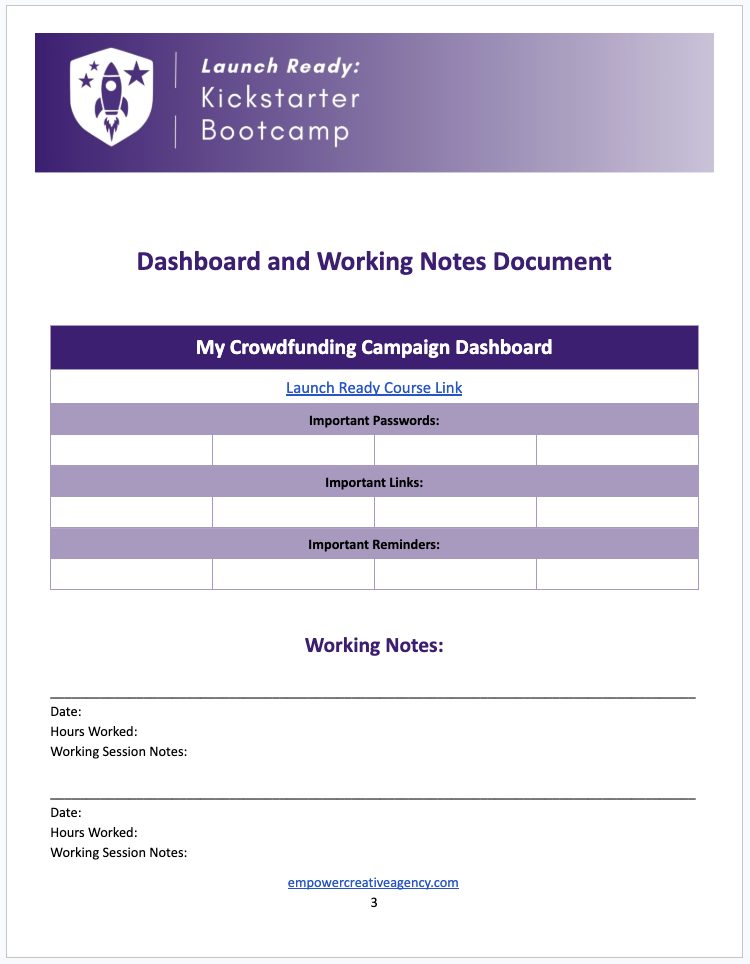
For this course, I've created a template Google Folder and a companion Google Doc called the Dashboard & Working Notes. Both are available for you to download and customize for your own project. At the end of this video, I'll show you how to make your own copy.
(Show Google Folder.)
Inside the Google Folder, you'll see a place to store all of the documents, worksheets, graphics, budgets, and other files you create throughout this bootcamp.
I recommend saving everything related to your crowdfunding campaign here. Having a cloud-based workspace means you can access your project from anywhere, easily share files with teammates if needed, and avoid searching through multiple folders when you're getting close to launch day.
Now let's open the Dashboard & Working Notes document.
(Open Google Doc.)
At the top, you'll find your dashboard.
Think of this as your project's home base.
This is where I keep information that I know I'll reference often, such as important website links, social media accounts, Canva projects, crowdfunding platform logins, and reminders.
One tip I'd like to share is to think ahead if you believe your project may eventually grow into a business or involve additional team members.
Rather than creating everything under your personal email address, consider creating a dedicated email account specifically for your project. You can use that email to create your social media accounts and other business logins. This makes it much easier to transfer ownership or collaborate with others in the future.
Of course, be thoughtful about security. Never store highly sensitive information in a shared document unless you're comfortable with the permissions you've set.
As you continue working on different projects, you'll probably customize your dashboard to fit your own style. Every project is a little different, and that's perfectly okay. The goal isn't to make it look exactly like mine—it's to create a system that works for you.
Now let's look at the Working Notes section.
This is probably my favorite part of the entire system.
I first learned this habit while conducting a mental health research study in college. Researchers often keep detailed notes throughout a project—not just about the final results, but about their observations, questions, decisions, and progress along the way.
I realized this approach works incredibly well for project management, too.
Every time I sit down to work on a project, I add the date and jot down what I accomplished during that work session. If I'm working with a client, I also keep track of my time and meeting notes here.
Over time, this document becomes a running history of the project. Instead of wondering, "Why did I make that decision?" or "When did I finish this task?" I have a record I can quickly reference.
I like to think of this as "clocking in" to your project. Every work session becomes part of your project's story.
One unexpected benefit is that you'll also begin to understand how long projects actually take you to complete. That's incredibly valuable information if you continue launching products or running your own business because it helps you plan future projects more accurately.
If you use AI tools as part of your workflow, your Working Notes can become even more valuable. After your project is complete—and after removing any sensitive information—you can ask an AI assistant to summarize your notes, identify common themes, estimate the total hours you spent, or help you create a "Lessons Learned" document. It's a great way to reflect on what worked well and what you'd like to improve before your next launch.
Using this organizational system is completely optional for this course.
However, as both a project manager and an entrepreneur, I can honestly say it's one of the simplest habits I've developed that has saved me countless hours over the years.
My hope is that this workspace helps you stay organized, reduces stress, and allows you to focus on what really matters—bringing your idea to life.
Now, let's make a copy of these templates so you can start organizing your own project.
5. (Optional) Make a Copy of Organized Google Folder
6. Join the LinkedIn Group
This is where you’ll post your completed content and get feedback from fellow students and your instructor(s).
5. Watch This Video
How to Use this Course and What You’ll Accomplish in 5 Weeks
-
Hi everyone! — As we jump into the course content, I'd like to spend a few minutes showing you how this bootcamp is organized and how you can get the most out of your experience.
This course is designed to be practical and project-based. Rather than simply watching videos, you'll be building your crowdfunding campaign step by step as we move through each lesson. By the end of the five weeks, you'll have a collection of completed documents that work together to form your campaign.
Think of each chapter as adding another piece to the puzzle. Every worksheet, template, and activity builds on the one before it, so I encourage you to complete the exercises as you go instead of saving them for later.
Throughout the course, you'll notice a few different TYPES of resources.
First, you'll have the video lessons. These are where I'll introduce new concepts, share examples, and walk you through each part of preparing your crowdfunding campaign.
Next, you'll find downloadable worksheets inside of your Course Workbook. These are designed to help you apply what you've learned directly to your own project. There are no right or wrong answers here—they're simply tools to help you think through your ideas and make steady progress.
You'll also receive templates that you can continue using long after the course ends. These include budgeting tools, competitor analysis worksheets, marketing planning templates, communication plans, and campaign writing templates. My hope is that these resources become part of your toolkit for future projects as well.
As we move through the course, I encourage you to pause the videos whenever you need to. Take your time with the activities, make notes, revisit earlier lessons if something isn't clear, and work at a pace that feels comfortable for you.
Now, let's take a quick look at what you'll accomplish over the next five weeks.
During Week One, we'll build a strong foundation. You'll learn how crowdfunding works, explore the different platforms available, evaluate whether your product is ready for crowdfunding, and begin thinking about your project's goals, pricing, and overall strategy.
In Week Two, we'll focus on your audience. You'll identify your ideal customers, research similar products and campaigns, and begin crafting the story that will connect your project with future backers.
During Week Three, we'll start building your campaign. You'll draft your crowdfunding page, develop your reward tiers, and create a storyboard and script for your campaign video.
In Week Four, we'll prepare for launch by creating your project budget, fulfillment plan, communication strategy, marketing timeline, and launch checklist. By the end of this week, you'll have all the major components of a launch-ready campaign assembled.
Finally, in Week Five, you'll submit your completed materials for personalized feedback. I'll review your campaign, provide suggestions and edits, and we'll wrap everything up with a live Q&A session where you can ask questions and prepare for your next steps.
One thing I'd like to mention is that this course is about preparation—not pressure.
Some students may feel ready to launch shortly after completing the course, while others may choose to spend several more weeks or even a few months refining their campaign, building their audience, and creating excitement before launch day. Both approaches are completely valid.
The goal is not to RUSH your project. The goal is to leave this bootcamp feeling organized, confident, and prepared.
Most importantly, I encourage you to enjoy the process. Creating something new is exciting, and every activity you complete brings your idea one step closer to becoming a reality.
Thank you again for joining me. I'm truly excited to see what you create over the next five weeks.
When you're ready, download the workbook if you haven't already, complete the "My Launch Goal" worksheet, and then continue to our first lesson, where we'll begin exploring the fundamentals of crowdfunding.
I'll see you in the next video!
6. Watch This Video
My Launch Goal
-
Before we jump into the exciting parts of crowdfunding (like designing your campaign page, creating reward tiers, and planning your marketing) I want to take a few minutes to step back and think about something even MORE important.
WHY are you doing this?
As project managers, entrepreneurs, and creators, it's really easy to get caught up in the day-to-day tasks of building something. We make checklists, create budgets, design graphics, and solve problems. Before long, we're so focused on getting everything done that we forget why we started in the first place.
That's why I always like to begin a project by defining the goal.
Every successful project starts with a clear understanding of what success actually looks like.
For some people, success might mean raising $5,000 through Kickstarter.
For someone else, it might mean proving that complete strangers are willing to buy their product.
Maybe your goal is to build confidence as a first-time entrepreneur, grow an audience around your idea, or finally launch a project you've been thinking about for years.
There isn't one "right" answer.
Your goal is personal.
The “My Launch Goal” worksheet is designed to capture where you are today—before we've learned all of the strategies and before you've had time to refine your campaign.
As you work through the questions, I encourage you not to overthink your answers.
They're not permanent.
They're simply a snapshot of your thinking today. In fact… add today’s date to your worksheet…. It’s just the answer that “today’s version of you” has!
Throughout this course, your ideas will probably change and that's actually a really good thing.
One of the biggest lessons I've learned as both a project manager and an entrepreneur is that great projects evolve over time. We gather feedback, learn from our audience, and make improvements along the way.
That's exactly what we'll be doing throughout this bootcamp.
As you complete the worksheet, you'll think about your project, the problem you're trying to solve, who you hope to help, and why crowdfunding feels like the right path for you.
You'll also take a moment to imagine what success looks like six months from now.
I love this exercise because it encourages us to think beyond launch day.
Crowdfunding isn't just about raising money.
It's about creating something meaningful, building a community, and taking the next step in bringing your idea into the world.
At the end of the worksheet, you'll notice one final question asking you to rate your confidence on a scale from one to ten.
There are no right or wrong answers here.
Maybe you're feeling like a two because you've never launched anything before.
Maybe you're already at an eight because you've been preparing for months.
Either answer is perfectly okay.
What's important is simply recognizing where you're starting.
My hope is that by the end of this course, you'll look back at this worksheet and realize just how much you've learned … AND how much your confidence has grown.
One final piece of encouragement before you begin:
If your answers feel a little messy... that's okay.
If you're still figuring things out... that's okay too.
Every successful entrepreneur starts somewhere.
No one begins with a perfect plan.
What matters is that you've taken the first step by showing up, committing to your project, and giving yourself permission to move forward.
I'm really excited to see where this journey takes you.
I encourage you not to throw this worksheet away. In Week Five, we're going to pull it back out and compare where you started to where you ended. My hope is that you'll not only have a launch-ready campaign, but that you’ll also have a clearer sense of yourself as a creator and entrepreneur.
When you're ready, pause the video, complete the My Launch Goal worksheet, and then come back for Chapter 2 so we can begin learning about the exciting world of crowdfunding together.
I'll see you in the next chapter!
7. Complete Worksheet
Worksheet: My Launch Goal
You can find this worksheet on PAGE 4 of the Chapter 1 Workbook.
8. Post Your Work to our LinkedIn Group
Take a screenshot or save your “My Launch Goal” worksheet as a PDF.
Upload and post to the class LinkedIn Group.
Reminder: You’ll get full instructor feedback on your materials during Week 5.
Congrats!
You’ve completed Chapter 1! You’re making GREAT progress.
Instructor Spotlight
🎤 Speaker: Paris Gramann

Paris Gramann (she/her) is a project manager, creative consultant, and entrepreneur with a multidisciplinary background spanning psychology, design research, education, marketing, and sustainable business strategy. As the founder of Empower Creative Agency, she specializes in executing meaningful projects that blend community impact with practical strategy. She has successfully designed and led initiatives ranging from children’s book development to e-learning modules, client media series, professional development workshops, and Kickstarter campaigns. With experience interviewing stakeholders, developing pitch decks, crafting content strategies, and managing complex timelines, she brings both structure and heart to every project. Paris’s work consistently centers empathy, accessibility, and mindful communication—whether she is supporting small businesses, developing content for families, or designing tools for neurodivergent-friendly daily life.