Week 1:
Week 2:
Week 3:
Week 4:
Week 1: Foundations
Chapter 3
Building a Fundable Project
A great idea is only the beginning. Successful crowdfunding campaigns are built on thoughtful planning. In this chapter, you'll learn how to create a realistic budget, price your rewards with confidence, and explore the key factors that contribute to successful campaigns. You'll also complete a hands-on pricing exercise to help prepare your project for launch.
1. Watch This Video
Building a Fundable Project
-
Welcome to Chapter 3!
So far, you've learned how crowdfunding works, explored different platforms, and evaluated whether your product is ready for launch.
Now it's time to answer a new question:
Can your project be funded—and can you successfully deliver what you promise?
In this chapter, we'll focus on the financial and strategic planning that turns a great idea into a fundable project.
First, we'll begin by building a realistic budget.
Many first-time creators underestimate the true cost of bringing a product to life. We'll talk about production costs, packaging, shipping, platform fees, and other expenses you may not have considered.
By the end of the lesson, you'll have a better understanding of how to estimate your costs and determine a funding goal that supports your project.
Next, we'll explore how to price your rewards.
Reward pricing is about finding the right balance between providing value to your backers and making sure your project remains financially sustainable.
We'll discuss how to calculate your costs, create attractive reward tiers, and avoid common pricing mistakes that can impact your campaign.
What Makes Campaigns Successful?
Finally, we'll take a look at what successful crowdfunding campaigns have in common.
We'll explore the importance of storytelling, building trust, creating strong visuals, engaging your audience, and maintaining momentum throughout your campaign.
While every project is different, there are proven principles that can help increase your chances of success.
Ultimately, by the end of this chapter, you'll have the tools to create a stronger financial plan, develop thoughtful reward tiers, and better understand what makes a crowdfunding campaign successful.
Don't worry if you don't have every answer yet. The goal is progress, not perfection. We'll continue building your campaign step by step, and each lesson will bring you one step closer to a confident, successful launch.
Let's get started!
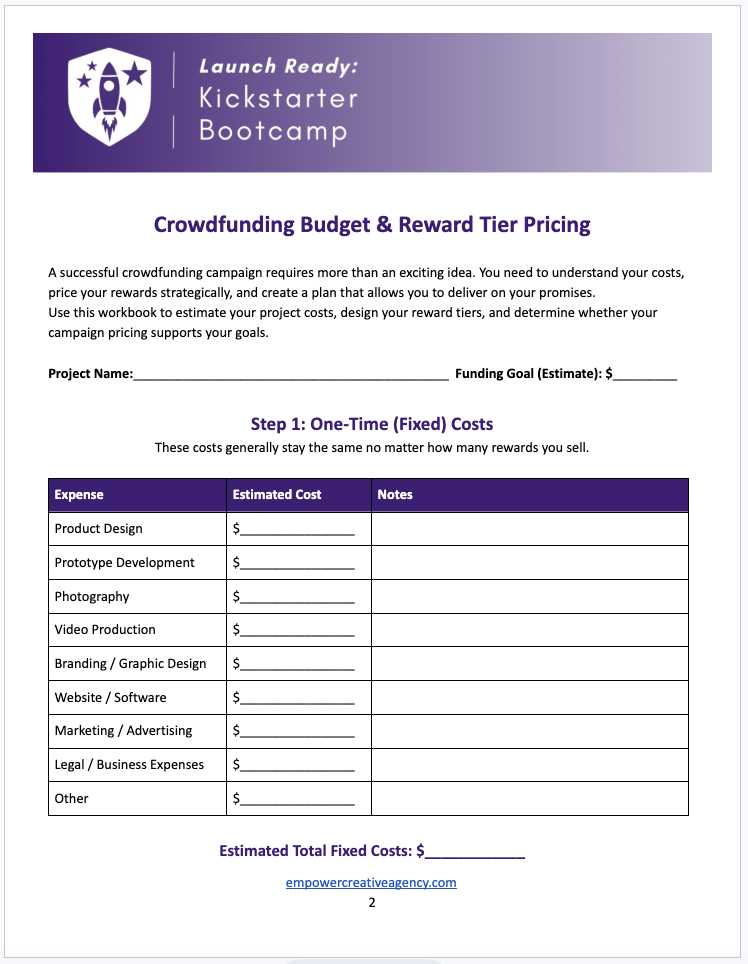
2. Download Chapter 3 Workbook
3. Watch This Video
Budgeting Basics
-
Welcome back!
One of the most common mistakes first-time creators make is setting a funding goal based on what they hope they need instead of what they actually need.
A realistic budget helps you price your rewards, set a funding goal, and deliver on your promises to your backers. In this lesson, we'll walk through the key costs you'll want to include before launching your campaign.
Additionally, we’ll talk a bit about funding psychology and “get on the bandwagon” type attitudes.
Why Budgeting Matters
Crowdfunding is exciting, but it's also a financial commitment.
When someone supports your campaign, they're trusting that you've planned ahead and can deliver what you've promised.
A well-planned budget helps you avoid running out of money, unexpected surprises, and delays. It also gives you confidence that your campaign goal is based on real numbers, not guesses.
Fixed vs. Variable Costs
A helpful place to start is understanding the difference between fixed and variable costs.
Fixed costs stay the same regardless of how many rewards you sell. These might include logo design, product photography, video production, or software subscriptions.
Variable costs increase as you receive more backers. These often include materials, manufacturing, packaging, shipping, and payment processing fees.
Knowing the difference will help you estimate how your costs change as your campaign grows… or if you make a few different budgets, based on backer estimates (example, a small budget if you only get 30 backers, or a large budget if you get 1,000 backers.)
Production, Packaging & Shipping
For physical products, production is often your largest expense.
Think through every step required to create your product, from raw materials and manufacturing to quality checks and assembly.
Next, don't forget packaging and shipping. Boxes, envelopes, labels, protective materials, and postage can add up quickly, especially if you're shipping internationally.
Additionally, depending on your project, you’ll want to consider items like copyrighting fees, getting your ISBN or barcode (if you’re making a book), or submitting for a patent.
Many creators underestimate these costs, so it's worth researching them early in your planning process.
A term you might hear during production is Minimum Order Quantity (MOQ). This is the smallest number of units a manufacturer is willing to produce in a single order. For example, if a manufacturer has an MOQ of 500, you'll need to order at least 500 units—even if you only want 200. Understanding a supplier's MOQ is an important part of planning your budget and setting a realistic crowdfunding funding goal.
Platform Fees & Contingency Planning
Another important expense is platform and payment processing fees.
Most crowdfunding platforms charge a percentage of the funds you raise, and payment processors also collect transaction fees. These are normal costs of running a campaign and should be included in your budget.
It's also wise to include a contingency buffer, which are extra funds set aside for unexpected expenses. Material prices, shipping costs, or production timelines can change, and a small buffer can help you manage those surprises without putting your project at risk.
Funding Psychology & Stretch Goals
Crowdfunding is about more than numbers…it's about momentum too. When a campaign reaches a large percentage of its funding goal early, it creates social proof that others believe in the project, which can encourage additional people to take a closer look and consider backing it.
For example, imagine two campaigns receive $3,000 on their first day. If one campaign has a $5,000 goal, it's already 60% funded and people may think, "Wow, this project is really taking off!" If the other campaign has a $20,000 goal, it's only 15% funded, and the same amount of support may not create the same sense of excitement. This is one reason it's important to set a realistic funding goal based on your actual budget… not simply the biggest number you think you can raise.
Once you've reached your funding goal, you can also introduce stretch goals. Stretch goals are additional milestones that unlock exciting bonuses if your campaign raises more than its original target. These rewards should add value for your backers while remaining inexpensive and realistic for you to provide. For example, a filmmaker who reaches their original funding goal before the deadline, might offer a downloadable movie poster to all backers, an author might share an exclusive first chapter from their next book to all backers, or a game creator might unlock bonus artwork or printable content for everyone. Stretch goals keep the excitement going after your campaign is funded and give your community another reason to continue sharing and supporting your project before the project reaches its deadline.
Now… Let’s work on determining Your Funding Goal
Once you've estimated your costs, you're ready to determine your funding goal.
Start by adding together all of your expected expenses, including production, shipping, fees, marketing, and your contingency buffer.
Your funding goal should reflect the amount you need to successfully deliver your project…not simply the amount you hope to raise.
Remember, your budget is a living document. As you gather quotes, test your product, and refine your plans, continue updating your numbers.
In your Chapter 3 Workbook, you can find a Crowdfunding Budget Planner to begin estimating your own project costs. A little planning now can make a big difference when it's time to launch.
I'll see you in the next lesson, where we'll explore how to price your rewards in a way that's both attractive to backers and sustainable for your project.
4. Watch This Video
Creating Reward Tiers That Work
-
Welcome back!
Now that you understand your budget, it’s time to talk about an important part of your crowdfunding campaign:
Your reward tiers.
Your rewards are how you turn supporters into backers. They help people understand what they receive, how much they want to contribute, and why your project is worth supporting.
Pricing your rewards is about covering your costs AND creating a balance between value for your backers and sustainability for your project.
In this lesson, we’ll talk about how to create reward tiers, how to price them, and how to use psychology to help backers confidently choose the right option.
First of all…. What Are Reward Tiers?
Reward tiers are different levels of support that offer different benefits.
Instead of asking everyone to contribute the same amount, you create options for different types of backers.
Some people may want a simple way to support your idea. Others may want the full experience, exclusive items, or a way to be more involved.
A strong reward structure usually includes:
An accessible entry-level option
A core product option
A premium option for your biggest supporters
Think of your tiers as a journey that allows people to choose the level of involvement that feels right for them.
Some people decide to do just three rewards tiers… Some people decide to do 5. There are different varying levels of what is expected and what some may consider “the best approach” in terms of how many tiers you provide… But since this is likely your first campaign, my suggestion is to start with three tiers.
The “Good, Better, Best” Approach
One popular way to structure rewards is the Good, Better, Best model.
Your “Good” tier gives people an easy way to join.
Your “Better” tier is usually your main offer: the option you expect many backers to choose because it provides the best balance of value and price.
Your “Best” tier is a premium experience for your biggest fans.
For example, imagine you are launching a children’s book series.
Your tiers could look like:
Good — $10
Digital version of the first book in the seriesBetter — $25
Physical signed copy of the first paperback book in the seriesBest — $75
Signed book collection (including all three paperback books in the series), a digital art print, and a personalized thank-you message from the authorEach tier gives more value, but the difference between them is clear.
The goal is not to create dozens of options. Too many choices can overwhelm backers. Simple, easy-to-understand tiers often create a better experience.
Let’s look at another example.
Imagine you are creating a new mobile app.
Your rewards might look different because your product is digital.
Good — $5
Access to first version of app + name listed in a thank-you sectionBetter — $25
One year of premium app access + name listed in a thank-you sectionBest — $100
Lifetime access, early feature testing, and a private community with the creators + name listed in a thank-you sectionFor a physical product, like a redesigned kitchen spatula, your tiers may include:
Good — $10
Supporter level with behind-the-scenes updatesBetter — $30
One spatula at the early-bird priceBest — $75
A bundle with multiple colors, accessories, or a limited-edition versionThe best rewards match the project. A book, app, and physical product will all have different ways to create value.
Internal Pricing Strategy — Making Sure Your Rewards Are Sustainable
Before you finalize your reward tiers, you need to work backward from your costs.
Let's use a children's book series as an example.
Imagine you are launching a three-book children's series. Your printer has a minimum order quantity, or MOQ, of 200 copies per book, and each physical book costs $4 to produce.
That means your first print run requires:
200 copies × 3 books = 600 total books
600 books × $4 production cost = $2,400 in printing costs alone
But remember—printing is only one part of your cost.
You also need to consider:
Packaging or mailers
Thank-you cards
Shipping labels
Postage
Platform fees
Payment processing fees
Any additional marketing or design costs
For example, if you estimate an additional $3 per physical book for packaging and shipping materials, your true cost per physical book may be closer to $7—not $4.
For books in the United States, creators can often reduce shipping costs by using USPS Media Mail, which is specifically designed for educational materials, books, and other eligible media. This can make fulfillment more affordable, but shipping costs should still be researched and included in your budget.
Now let's look at your reward tiers.
A simple structure might be:
Good — $10
Digital version of the first book in the seriesThis is a low-cost entry point that allows people to support your project without adding fulfillment expenses.
Better — $25
Signed physical copy of the first paperback bookThis is likely your core reward tier—the option most backers will choose.
Best — $75
Signed collection of all three books, digital art print, and personalized thank-you messageThis sounds exciting, but before offering a three-book bundle, ask yourself:
Do I have enough demand for all three books?
Can I afford the larger print order?
Will this create more fulfillment complexity?
For a first campaign, it may be smarter to launch with the first book as the main product and offer future books as stretch goals or future campaigns.
Remember: The best reward is not always the biggest bundle. The best reward is the one that creates excitement for backers while allowing you to confidently deliver what you promised.
Your goal is to create rewards that people want to buy … and that your project can sustainably fulfill.
SO, something you could consider… is offering the second and third books as digital books in the highest offer. While additionally giving 3 signed copies of the first book to the “best” backer reward tier.
Pricing Psychology
There is also a psychology behind pricing.
One important concept is anchoring.
People often compare options against the other choices they see. A premium tier can help make your middle tier feel like the best value.
For example, if someone sees:
$25 basic option
$50 popular option
$150 premium option
The $50 option may feel like the most reasonable choice because it sits between the two extremes.
Another strategy is creating early-bird rewards. Early supporters feel rewarded for taking a chance on your project, while creators benefit from building early momentum.
Please remember: pricing should never trick people. Your goal is to make the value clear and help backers choose the option that fits them.
Stretch Goals
Once you reach your funding goal, you can introduce stretch goals.
Stretch goals are additional milestones that unlock bonuses when your campaign exceeds its original target.
The best stretch goals are exciting for backers but low-cost and manageable for creators.
Some examples include:
A downloadable poster for a film project
Bonus artwork for a book
An exclusive first chapter of the next book in a series
Additional digital resources for an online course
For example:
“If we reach $10,000, every backer will receive an exclusive art print.”
Stretch goals help keep your community engaged after you reach your original goal and give supporters another reason to share your campaign.
Your reward tiers are as important as price points. They are part of your campaign story.
The strongest campaigns make it easy for people to understand the value, choose their level of support, and feel excited to be part of bringing your project to life.
In the next lesson, we’ll explore what makes campaigns successful and the strategies that help projects build momentum.
See you there!
5. Watch This Video
What Makes Campaigns Successful?
-
Welcome to the final lesson of Chapter 3!
By now, you've evaluated your project, created a draft budget, and started thinking about your reward tiers.
But here's an important question:
Why do some crowdfunding campaigns reach their goals while others struggle?
Although every project is different, successful campaigns often have several key characteristics in common. In this lesson, we'll explore the habits and strategies that help campaigns build trust, attract backers, and maintain momentum.
They Solve a Clear Problem
Successful campaigns start with a product that provides value.
Ask yourself:
What problem does my project solve?
Who is it for?
Why should someone care?
Your project doesn't have to change the world—it simply needs to solve a meaningful problem or create an experience that people genuinely want.
The clearer your value proposition, the easier it is for potential backers to understand why they should support your campaign.
They Tell a Great Story
People don't just back products—they back people and ideas.
Your campaign should tell the story behind your project.
Share:
Why you created it.
The problem you noticed.
Your journey so far.
What this funding will help you accomplish.
A compelling story helps people connect emotionally with your project while understanding the practical value it provides.
They Build Trust
Crowdfunding asks people to support something before it exists, so trust is essential.
Build confidence by showing:
A working prototype or sample.
Clear photos and videos.
A realistic production timeline.
Honest communication about risks and challenges.
If people believe you have done your homework and can deliver what you've promised, they are much more likely to become backers.
They Prepare Before Launch
One of the biggest misconceptions about crowdfunding is that campaigns become successful after they launch.
In reality, much of the work happens beforehand.
Successful creators often spend weeks or months:
Testing their product.
Building an audience.
Growing an email list.
Creating marketing materials.
Planning social media content.
Asking friends, family, and early supporters to help create momentum on launch day.
The launch is not the beginning of your campaign—it's the result of your preparation.
They Keep Communicating
Finally, successful creators continue showing up throughout their campaign.
They post updates.
They answer questions.
They thank their backers.
They celebrate milestones.
And if something changes, they communicate honestly and promptly.
Backers appreciate transparency, and consistent communication helps build a stronger community around your project.
Remember, crowdfunding is more than raising money—it's about building relationships with the people who believe in your idea.
In Closing
Successful crowdfunding campaigns aren't built on luck.
They're built through thoughtful planning, clear communication, realistic budgeting, and a product that people are excited to support.
As you continue through this course, you'll learn how to bring all of these pieces together into a campaign that reflects both your vision and your preparation.
I'll see you in the next chapter!
6. Complete Worksheet
Worksheet: Crowdfunding Budget & Reward Tier Pricing
This worksheet can be found on PAGE 2 of your Chapter 3 Workbook.
7. Post Your Work to our LinkedIn Group
Take a screenshot or save your worksheets as a PDF.
Upload and post to the class LinkedIn Group.
Reminder: You’ll get full instructor feedback on your materials during Week 5.
Congrats!
You’ve completed Chapter 3! You are so much closer to your goals.
Instructor Spotlight
🎤 Speaker: Paris Gramann

Paris Gramann (she/her) is a project manager, creative consultant, and entrepreneur with a multidisciplinary background spanning psychology, design research, education, marketing, and sustainable business strategy. As the founder of Empower Creative Agency, she specializes in executing meaningful projects that blend community impact with practical strategy. She has successfully designed and led initiatives ranging from children’s book development to e-learning modules, client media series, professional development workshops, and Kickstarter campaigns. With experience interviewing stakeholders, developing pitch decks, crafting content strategies, and managing complex timelines, she brings both structure and heart to every project. Paris’s work consistently centers empathy, accessibility, and mindful communication—whether she is supporting small businesses, developing content for families, or designing tools for neurodivergent-friendly daily life.