Week 1:
Week 2:
Week 3:
Week 4:
Week 1: Foundations
Chapter 2
Crowdfunding Fundamentals
Every successful crowdfunding campaign starts with a strong foundation. In this chapter, we'll explore the basics of crowdfunding, discuss the strengths of different crowdfunding platforms, and learn what it means to have a minimum viable product (MVP). You'll also take an honest look at whether your project is ready to launch… OR what steps you can take to get it there. Remember, the goal isn't perfection. The goal is to create a product that's ready to be tested, shared, and improved with the help of your future community.
Watch This Video
What is Crowdfunding?
-
Hi everyone, and welcome to our first lesson on crowdfunding!
Before we start talking about budgets, marketing, reward tiers, or campaign pages, we need to answer one simple question:
What exactly is crowdfunding?
At its core, crowdfunding is a way of bringing a community of people together to help make an idea become reality.
Instead of receiving funding from one large investor, a bank, or a traditional lender, crowdfunding allows many individuals (often called backers) to each contribute a smaller amount of money toward a project they believe in.
When enough people come together, those smaller contributions can provide the funding needed to launch a new product, publish a book, manufacture an invention, create a film, develop a game, or bring countless other creative ideas to life.
One thing that's important to understand is that crowdfunding isn't simply about asking people for money.
It's about inviting people to become part of your journey.
Here’s an important term you'll hear throughout this course: backers.
Backers are the people who choose to support your campaign. Depending on the type of crowdfunding you're using, they may receive a reward, an early version of your product, exclusive content, or simply the satisfaction of helping bring your idea into the world.
In many ways, your backers become your earliest customers, your biggest supporters, and sometimes even your biggest advocates. They often share your project with friends and family because they want to see it succeed just as much as you do.
Now let's compare crowdfunding with traditional fundraising.
Traditional fundraising often involves asking a small number of organizations, investors, or donors for large amounts of money. These decisions are usually made by only a handful of people.
Crowdfunding works differently.
Instead of convincing one person to invest thousands of dollars, you're inviting hundreds (or sometimes thousands) of people to each contribute a smaller amount they're comfortable with.
That means your campaign isn't just raising money.
It's also validating your idea.
If people you've never met are willing to support your project, that's a powerful signal that your product or idea has real potential.
But often times, we start with our own network and maybe a few strangers find out about it along the way… We’ll dive into how to tap into your network later in the course.
Another important distinction to discuss is the difference between rewards-based crowdfunding and donation-based crowdfunding.
In a donation-based campaign, supporters contribute because they believe in a cause or want to help someone. They generally don't expect to receive a product in return.
This model is commonly used for charitable causes, medical expenses, disaster relief, nonprofit organizations, or community projects.
Rewards-based crowdfunding works a little differently.
Instead of making a donation, supporters receive something in return for their pledge. That could be an early copy of your book, your new product, exclusive merchandise, a behind-the-scenes experience, or another reward that you've created specifically for your campaign.
Throughout this bootcamp, we'll primarily focus on rewards-based crowdfunding, since that's the model used by platforms like Kickstarter.
Before we finish this lesson, I'd like to introduce a few common terms that you'll hear throughout the course.
A campaign is your crowdfunding project as a whole—everything that appears on your crowdfunding page, including your story, rewards, photos, videos, and funding goal.
A backer is someone who supports your campaign financially.
A reward tier is a specific level of support that offers a particular reward. For example, someone who contributes $25 might receive one product, while someone who contributes $75 might receive a bundle of products or an exclusive experience.
You'll also hear the phrase funding goal. This is the amount of money you're hoping to raise during your campaign. Choosing that number carefully is incredibly important, and we'll spend time later in the course learning how to calculate a realistic goal.
When you download the Chapter 2 Workbook (your next step after this video), you’ll see a glossary of the terms I just listed (and a few more) included at the front of the document.
Finally, remember this:
Crowdfunding isn't just about raising money.
It's about testing an idea, building a community, telling a compelling story, and inviting people to become part of something meaningful.
Many entrepreneurs discover that one of the greatest benefits of crowdfunding isn't simply the funding itself, but it is the relationships they build with their earliest supporters.
As we continue through this course, we'll build on these foundations one step at a time.
In the next lesson, we'll compare several popular crowdfunding platforms and help you determine which one is the best fit for your project.
I'll see you there!
2. Download Chapter 2 Workbook
3. Watch This Video
Choosing the Right Crowdfunding Platform for Your Project
-
In this lesson, we’re going to talk about one of the most important decisions you’ll make before launching your crowdfunding campaign: choosing the right platform.
A common mistake creators make is assuming that all crowdfunding platforms work the same way. They don’t.
Each platform has a different audience, funding model, fee structure, and purpose. The best platform for your project depends on what you are creating, who you’re trying to reach, and how you plan to engage your supporters.
By the end of this lesson, you’ll understand the differences between the most common crowdfunding options and be able to choose the platform that best fits your goals.
KICKSTARTER
Let’s start with one of the most well-known crowdfunding platforms: Kickstarter.
Kickstarter is designed primarily for creative projects and innovative products.
Creators use Kickstarter to launch things like:
Books
Games
Films
Technology products
Art projects
Design products
Educational resources
One of Kickstarter’s biggest strengths is that it has a built-in community of people who are actively looking for new ideas to support.
However, Kickstarter uses an all-or-nothing funding model.
That means you set a funding goal, and if you do not reach that goal by your deadline, you typically do not receive the funds.
This model can create urgency and excitement, but it also means preparation is extremely important. Successful Kickstarter campaigns usually have:
A clear product or idea
A realistic budget
A strong audience before launch
A plan for marketing and communication
Kickstarter is a great fit if you are launching something new and want to build a community around your project.
Indiegogo
Another popular platform is Indiegogo.
Indiegogo is similar to Kickstarter in that it supports creative projects, products, and innovations. However, it offers some additional flexibility.
One major difference is that Indiegogo allows creators to choose between different funding options, including keeping funds raised even if they do not reach their original goal.
This can be helpful for projects that can move forward with partial funding.
Indiegogo is often used for:
New technology products
Consumer products
Innovative ideas
Hardware projects
If your project needs flexibility and you are comfortable managing a campaign with different funding outcomes, Indiegogo may be a good option.
GoFundMe
Next, let’s talk about GoFundMe.
GoFundMe is different from platforms like Kickstarter and Indiegogo because it is primarily focused on personal causes, community needs, and charitable fundraising.
Examples include:
Medical expenses
Emergency support
Community projects
Personal fundraising efforts
GoFundMe is generally not designed for launching a product where backers receive rewards.
Instead, supporters contribute because they believe in the cause or want to help.
If your goal is raising money for a personal or community need rather than creating and delivering a product, GoFundMe may be the better fit.
Self-Hosted Crowdfunding
Another option is self-hosted crowdfunding.
This means creating your own crowdfunding experience through your website, ecommerce platform, or other tools.
The biggest advantage is control.
You own:
The customer relationship
The website experience
The data
The branding
However, the biggest challenge is that you are responsible for bringing your own audience.
Unlike Kickstarter or Indiegogo, people are not browsing a marketplace looking for projects to support. (Although to caveat, with Kickstarter or Indiegogo, you have to still do a TON of your own marketing… it’s only a minor plus that someone might happen upon your project.)
Self-hosted crowdfunding works best if you already have:
An established audience
A strong email list
A community that trusts you
Marketing experience
Membership Platforms
Finally, let’s talk about membership platforms.
Membership platforms are designed for ongoing support rather than one-time campaigns. Creators build a community where members pay regularly in exchange for exclusive content, resources, or experiences.
Some Examples of membership platforms include:
Patreon — For creators offering exclusive content, behind-the-scenes access, or community experiences.
Substack — For writers, educators, and experts offering paid newsletters.
Ko-fi — For artists and creators offering memberships or supporter perks.
Mighty Networks — For creators building paid communities, courses, or networks.
This might be the Best fit for your project IF: If you want to build a long-term relationship with your audience through recurring support.
An Example of this might be: A writer offers monthly members early access to chapters, bonus content, and writing discussions.
Key difference:
Crowdfunding helps you fund one project. Memberships help you build ongoing support.If you’re just starting out… it might make sense to do a crowdfunding platform that just funds one project … and build your membership platform at a later time.
Choosing the Right Platform
So how do you decide which platform is right for you?
Start by asking yourself these questions:
First: What are you creating?
Is it a product, creative project, personal cause, or ongoing community?Second: Do you already have an audience?
If you have an existing community, self-hosted options may work well. If you are looking for discovery, platforms like Kickstarter may provide more visibility. And as a reminder, either way, you’ll have to do some heavy lifting to tap into your network.Third: Do you need all-or-nothing funding or flexibility?
Fourth: What relationship do you want with your supporters?
Are they customers, donors, or long-term community members?There is no single “best” crowdfunding platform.
The best platform is the one that matches your project, your audience, and your launch strategy.
In your Chapter 2 Workbook, you’ll see the Crowdfunding Platform Comparison Guide to help you compare your options and identify the best fit for your campaign.
In the next lesson, we’ll talk about what makes a strong MVP (or… Minimal Viable Product) and how to determine whether your product is ready for crowdfunding.
See you there!
4. Watch This Video
What Makes a Great MVP?
-
Welcome back!
Let’s get into the concept of: a Minimum Viable Product
Before launching a crowdfunding campaign, one of the most important questions you need to answer is:
“Is my product ready?”
Many creators make one of two mistakes:
1 – they make the mistake of waiting until everything is perfect before sharing their idea with the world.
OR 2 – Others launch too early without enough testing or customer feedback.
The goal is to find the right balance.
That’s where the concept of an MVP — or Minimum Viable Product — comes in.
In this lesson, we’ll explore what an MVP really means, common misconceptions, examples of MVPs, and how to know when your product is “ready enough” for crowdfunding.
First of all… What Is an MVP?
An MVP is the simplest version of a product that allows you to test your idea with real users and learn from their feedback.
The key word is not “minimum.”
The key word is viable.
An MVP still needs to provide real value. It should solve a problem, meet a need, or deliver an experience that customers can understand and evaluate.
An MVP is not a rough idea on a napkin.
It is not a product that is broken or unusable.
Instead, it is a version that includes the essential features needed to test whether people want and value your solution.
For crowdfunding, an MVP helps you answer important questions:
Do people actually want this product?
Are they willing to pay for it?
What features matter most?
What improvements should you make before a larger launch?
Common MVP Misconceptions
There are several common misunderstandings about MVPs.
Misconception #1: An MVP is a bad or unfinished product.
Not true.
An MVP may look different from the final version, but it should still provide a meaningful experience.
Misconception #2: An MVP needs every feature.
Actually, the opposite is true.
An MVP focuses only on the features that are necessary to solve the main customer problem.
Misconception #3: An MVP is only for technology products.
MVPs can apply to almost anything:
Physical products
Books
Courses
Events
Food products
Creative projects
Any time you are testing whether people want something, you are working toward an MVP.
Examples of MVPs
Let’s look at a few examples of MVPS.
Imagine someone wants to create a new smart kitchen device.
The final product might include:
A beautiful design
A mobile app
Multiple features
Premium packaging
But the MVP might simply be a working prototype that proves the main function and allows customers to test the idea.
For a book project, the MVP could be:
A completed manuscript
A sample chapter
Early reader feedback
A small group of beta readers
For an online course, the MVP could be:
A first version of the curriculum
A small pilot group
Feedback from early students
The MVP is about proving the core value before investing heavily in the final version.
For any MVP that is being shared with the world, make sure you consider anything like copyrights or patents if you’re project calls for it.
When Is Something “Ready Enough”?
So how do you know when your product is ready enough for crowdfunding?
Ask yourself:
Can people understand what this product does?
If someone sees your product, can they quickly understand the problem it solves?
Can people experience the value?
Do you have something tangible they can see, test, or imagine using?
Have you received feedback from real people?
Talking with potential customers before launching can help you identify improvements and avoid expensive mistakes.
Can you realistically deliver what you promise?
A great idea is not enough. You also need a plan for production, fulfillment, and communication.
Your MVP does not need to be perfect — but it should be credible.
Beta Products vs Finished Products
Finally, let’s talk about the difference between a beta product and a finished product.
A beta product is still being tested and improved. Early users understand they are helping shape the final version through feedback.
A finished product is the version that has gone through testing, improvements, and preparation for full delivery.
Many successful crowdfunding campaigns launch somewhere in between.
They have a strong enough product to demonstrate value, but they also leave room for improvement based on customer feedback.
Remember:
Your MVP is not the final destination.
It is the bridge between your idea and a product people truly want.
In the next lesson, we’ll talk about how to determine whether your product is truly ready for crowdfunding and what preparation needs to happen before launch.
See you there!
5. Watch This Video
Is Your Product Ready for Crowdfunding?
-
Is Your Product Ready?
Evaluating Your Project Before Launch
In the last lesson, we talked about the importance of creating a Minimum Viable Product (a version of your idea that allows you to test, learn, and improve.)
Now it’s time to ask an important question:
Is your product ACTUALLY ready for crowdfunding?
A successful campaign is not just about having a great idea. Backers are supporting a product, a solution, and a creator they trust.
Before launching, you need to evaluate where your project stands, what you have already validated, and what still needs improvement.
In this lesson, we’ll walk through the key questions you should ask before launching your campaign.
Has Someone Used It?
The first question is:
Has someone actually used your product?
It can be tempting to believe that people will love an idea because it makes sense to you.
But real-world feedback is one of the most valuable tools you have.
Try sharing your prototype, sample, or early version with potential customers.
Watch how they interact with it.
Do they understand how it works?
Do they see the value?
Do they have questions or frustrations?Even a small group of testers can provide insights that help you make your product stronger before launch.
Let’s look at a few examples.
Imagine you are creating a children’s book series. Before launching your campaign, you might share a sample book with parents, caregivers, teachers, or children. Do children want to look at the pages? Do parents understand the purpose of the book? Do they find the design, illustrations, and message valuable? This feedback can help you improve the story, format, and overall experience before printing a larger quantity.
Now imagine you are creating a new spatula with a unique design. Instead of only asking people if they like the idea, create a prototype and let people use it in their kitchens. Does the design make cooking easier? Is it comfortable to hold? Does it solve a frustration people have with traditional spatulas? Observing real people use the product can reveal improvements you may not have considered.
The goal is not to prove that your first version is perfect. The goal is to learn what works, what needs improvement, and whether your product creates real value for the people you want to serve.
Have You Gathered Feedback?
The next question is:
Have you gathered feedback — and acted on it?
Feedback is not just about asking, “Do you like this?”
You want to understand:
What problem does this solve for you?
What would make this product better?
What would prevent you from buying it?
What features matter most?
The goal is not to collect compliments.
The goal is to learn.
Sometimes feedback confirms that you are on the right path. Other times, it reveals important changes you need to make before launching.
Does It Solve a Problem?
A strong crowdfunding project solves a problem, meets a need, or creates meaningful value.
Ask yourself:
Why does this product need to exist?
What frustration, challenge, or desire does it address?
Products that succeed on crowdfunding platforms often have a clear story:
“Here is a problem people experience.”
“Here is why current solutions are not enough.”
“Here is how our product creates a better experience.”Your product does not have to solve a massive global problem.
It just needs to solve a problem that matters to a specific group of people.
Does It Photograph Well?
Crowdfunding is a visual experience.
Before someone becomes a backer, they will usually see your:
Photos
Videos
Graphics
Campaign page
Ask yourself:
Can someone understand the value of my product by looking at it?
If your product is physical, do you have clear images showing:
What it is
How it works
How someone uses it
If your project is a book, course, or creative work, can you visually communicate the experience someone will receive?
A great product still needs great storytelling.
Would Someone Pay for It Today?
One of the most important questions is:
Would someone pay for this product today?
Not someday.
Not after a few more improvements.Today.
This does not mean your product has to be perfect.
It means you have evidence that someone sees enough value to exchange money for it.
Ways to test this include:
Pre-orders
Customer interviews
Surveys
Beta sales
Early access offers
Interest is valuable, but willingness to pay is the strongest form of validation. Your crowdfunding campaign ultimately IS your pre-order and way to test this… but can you get validation before you get started?
What Still Needs Improvement?
Finally, ask:
What still needs improvement?
Every product has areas that can be refined.
Consider:
Design improvements
Production challenges
Pricing
Packaging
Customer experience
Timeline
Delivery process
The goal is not to eliminate every possible problem before launch.
The goal is to understand your risks and create a realistic plan.
A successful crowdfunding creator knows both:
What is working
What still needs attention
Before you launch, make sure you can confidently answer:
“Yes, people understand this product.”
“Yes, people want this product.”
“Yes, I can deliver this product.”If you can answer those questions, you are much closer to being campaign-ready.
In the next lesson, we’ll start exploring how to prepare your crowdfunding strategy and set yourself up for a successful launch.
See you there!
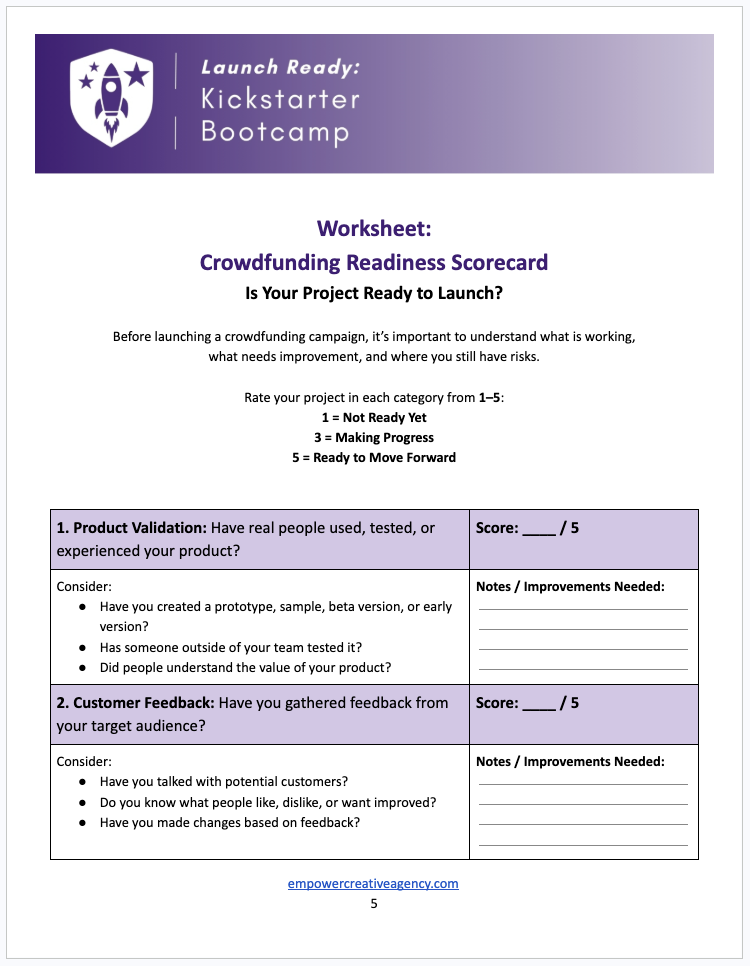
6. Complete Worksheet
Worksheet: Crowdfunding Readiness Scorecard
You can find this worksheet on PAGE 5 of the Chapter 2 Workbook.
7. Post Your Work to our LinkedIn Group
Take a screenshot or save your “My Launch Goal” worksheet as a PDF.
Upload and post to the class LinkedIn Group.
Reminder: You’ll get full instructor feedback on your materials during Week 5.
Congrats!
You’ve completed Chapter 2! You are starting to make this a reality.
Instructor Spotlight
🎤 Speaker: Paris Gramann

Paris Gramann (she/her) is a project manager, creative consultant, and entrepreneur with a multidisciplinary background spanning psychology, design research, education, marketing, and sustainable business strategy. As the founder of Empower Creative Agency, she specializes in executing meaningful projects that blend community impact with practical strategy. She has successfully designed and led initiatives ranging from children’s book development to e-learning modules, client media series, professional development workshops, and Kickstarter campaigns. With experience interviewing stakeholders, developing pitch decks, crafting content strategies, and managing complex timelines, she brings both structure and heart to every project. Paris’s work consistently centers empathy, accessibility, and mindful communication—whether she is supporting small businesses, developing content for families, or designing tools for neurodivergent-friendly daily life.